
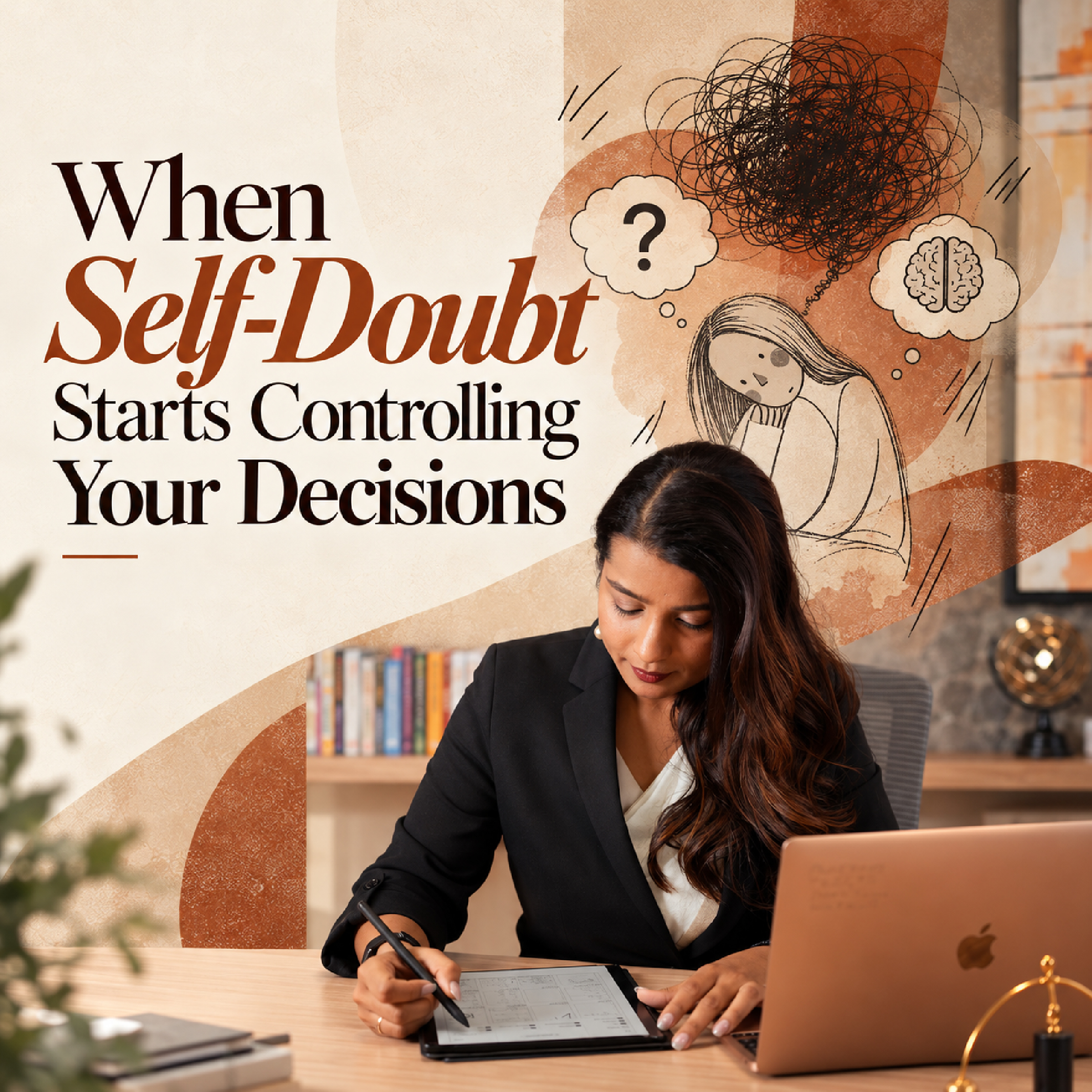
When Self-Doubt Starts Controlling Your Decisions
Self-doubt can make even simple decisions feel difficult. Here is why you second-guess yourself, and how to trust your own judgment again.
Have you ever known what you wanted to do but still asked everyone else what they thought? You make a decision. Then you question it. Then you think about the alternatives. Then you wonder whether someone else would have made a better choice. And eventually, you are back where you started. Doubting yourself.
Self-doubt can be surprisingly quiet. It does not always sound like, “I can’t do this.” Sometimes it sounds like:
- “Maybe I should wait.”
- “What if I’m wrong?”
- “Maybe someone else knows better.”
- “What if I regret this?”
- “Am I really ready?”
The more often these thoughts influence your choices, the easier it becomes to lose trust in your own judgment. That’s where self-doubt can become more than an uncomfortable feeling. It can start controlling your decisions.
What Is Self-Doubt?
Self-doubt is the uncertainty you experience about your abilities, choices, judgment or worth. Everyone experiences it occasionally. You may question yourself before an important presentation, a difficult conversation, a career decision, or a major life change.
The problem begins when questioning yourself becomes your default response. Instead of using reflection to make a better decision, you use doubt to delay the decision.
Instead of asking, “What is the best choice for me?” you keep asking, “What if I make the wrong choice?” That small shift can change everything.
Why Do We Second-Guess Ourselves?
There is often a deeper reason behind self-doubt.
- Sometimes, you have experienced failure before.
- Sometimes, you have been criticised repeatedly.
- Sometimes, you grew up believing that mistakes were unacceptable.
- Sometimes, you have spent so much time comparing yourself with others that your own judgment no longer feels trustworthy.
And sometimes, you simply want a guarantee that your decision will work out. But life rarely gives us guarantees.
When you demand certainty before making a decision, even simple choices can become exhausting. You may keep searching for more information, more opinions, and more reassurance. Yet the more you search, the more possibilities you discover. And suddenly, overthinking decisions replaces decision-making.
5 Signs Self-Doubt May Be Influencing Your Decisions
1You Constantly Seek Reassurance
You have already made a decision. But you ask your friend. Then your partner. Then your colleague. Then maybe Google. Then you still aren’t sure.
Getting another perspective can be useful. But if you cannot trust yourself without someone else confirming your choice, it may be worth exploring what is underneath that need for reassurance.
Ask yourself: “Am I looking for information, or am I looking for permission to trust myself?”
That question can reveal a lot.
2You Keep Waiting to Feel Completely Ready
You tell yourself: “I’ll do it when I’m more confident.”
But confidence rarely arrives before action. Often, confidence develops because you take action and discover that you can handle what happens next. Waiting until you feel completely ready can therefore become another form of avoidance.
You do not need absolute confidence to take the next step. You need enough trust to begin.
3You See Mistakes as Proof That You Were Wrong
Making a mistake does not automatically mean you made a bad decision. Sometimes, you can make the best decision possible with the information you had at the time and still get an unexpected result. That is part of being human.
If every mistake becomes evidence that you cannot trust yourself, self-doubt becomes stronger.
One question creates learning. The other can create self-criticism.
4You Compare Your Decisions with Everyone Else’s
Someone else seems more confident. Someone else appears to have figured out their career. Someone else seems to know exactly what they want. And suddenly, your own path feels inadequate.
But you are comparing your internal experience with someone else’s external presentation. You see their decision. You don’t see all the uncertainty that came before it.
Constant comparison can make you question choices that may actually be right for you. Your life does not need to look like someone else’s to be meaningful.
5You Overthink Long After the Decision Is Made
The decision is already done. But your mind keeps reopening the case. “Should I have said that?” “Maybe I should have chosen the other option.” “What if this doesn’t work?”
This is where self-doubt and overthinking can become closely connected. Your mind keeps trying to rewrite the past because it wants certainty about the future. But no amount of analysing yesterday can guarantee tomorrow.
Sometimes, you have to let a decision be complete.
How to Stop Doubting Yourself So Much
The goal is not to eliminate every doubt. Healthy reflection has value. The goal is to stop self-doubt from becoming the person deciding for you.
Start With What You Know
When you are uncertain, separate facts from fears. Ask:
- “What do I know?”
- “What am I assuming?”
- “What am I afraid might happen?”
These three questions can help you see the difference between reality and the story your mind is creating.
Stop Asking for Perfect Certainty
There will be decisions where you simply cannot know the outcome. You can research. You can prepare. You can ask for advice. But eventually, you have to choose.
A decision does not need to be perfect to be worthwhile. Sometimes you simply need to make the best decision you can with the information available to you today.
Notice Your Inner Voice
Pay attention to how you speak to yourself. Would you speak to a close friend the way you speak to yourself after making a mistake? Probably not.
Self-criticism often disguises itself as motivation. You think being hard on yourself will make you perform better. But constantly attacking yourself can make it even harder to act with clarity and confidence.
That is not empty positivity. It is a more balanced way of looking at yourself.
Can Self-Acceptance Help With Self-Doubt?
Self-acceptance does not mean believing that every decision you make will be right. It means knowing that your worth does not depend on always being right. That distinction is powerful.
When you accept yourself, you do not have to turn every mistake into a personal failure. You can make a decision. Learn from it. Change direction if necessary. And continue. This creates a healthier relationship with uncertainty.
That is a very different mindset.
For people who struggle with self-doubt, emotional awareness and self-acceptance can be useful starting points for understanding the patterns behind their thoughts and reactions. You can explore more about Riddhi’s approach through her Acceptance Coaching.
What If You Trusted Yourself a Little More?
- Imagine deciding without needing five people to approve it.
- Imagine making a mistake without immediately questioning your intelligence.
- Imagine changing your mind without calling yourself inconsistent.
- Imagine taking an opportunity without waiting until you feel 100% confident.
That does not mean becoming reckless. It means developing a relationship with yourself where you can say: “I may not know exactly what will happen. But I trust myself to handle what comes next.”
That is self-trust. And self-trust is not built by thinking about yourself more. It is built by experiencing yourself as someone who can make a choice, face the outcome and keep going.
A Final Reflection
The next time you catch yourself second-guessing a decision, pause.
Ask yourself: “Am I genuinely looking for clarity?” Or “Am I afraid to trust myself?”
You may not always make the perfect choice. Nobody does. But you can learn to stop treating every uncertain decision as evidence that something is wrong with you. You can listen to advice without abandoning your own voice. You can consider other perspectives without losing your own judgment. And you can make mistakes without making yourself the mistake.
You don’t need to become someone who never doubts themselves. You simply need to become someone who doesn’t let doubt make every decision for them.
Self-Doubt: Sometimes, the confidence you’re waiting for is built only after you decide to trust yourself.
With acceptance,
Riddhi Saboo Tahalramani
Acceptance Coach | Emotional Awareness Mentor









Comments