
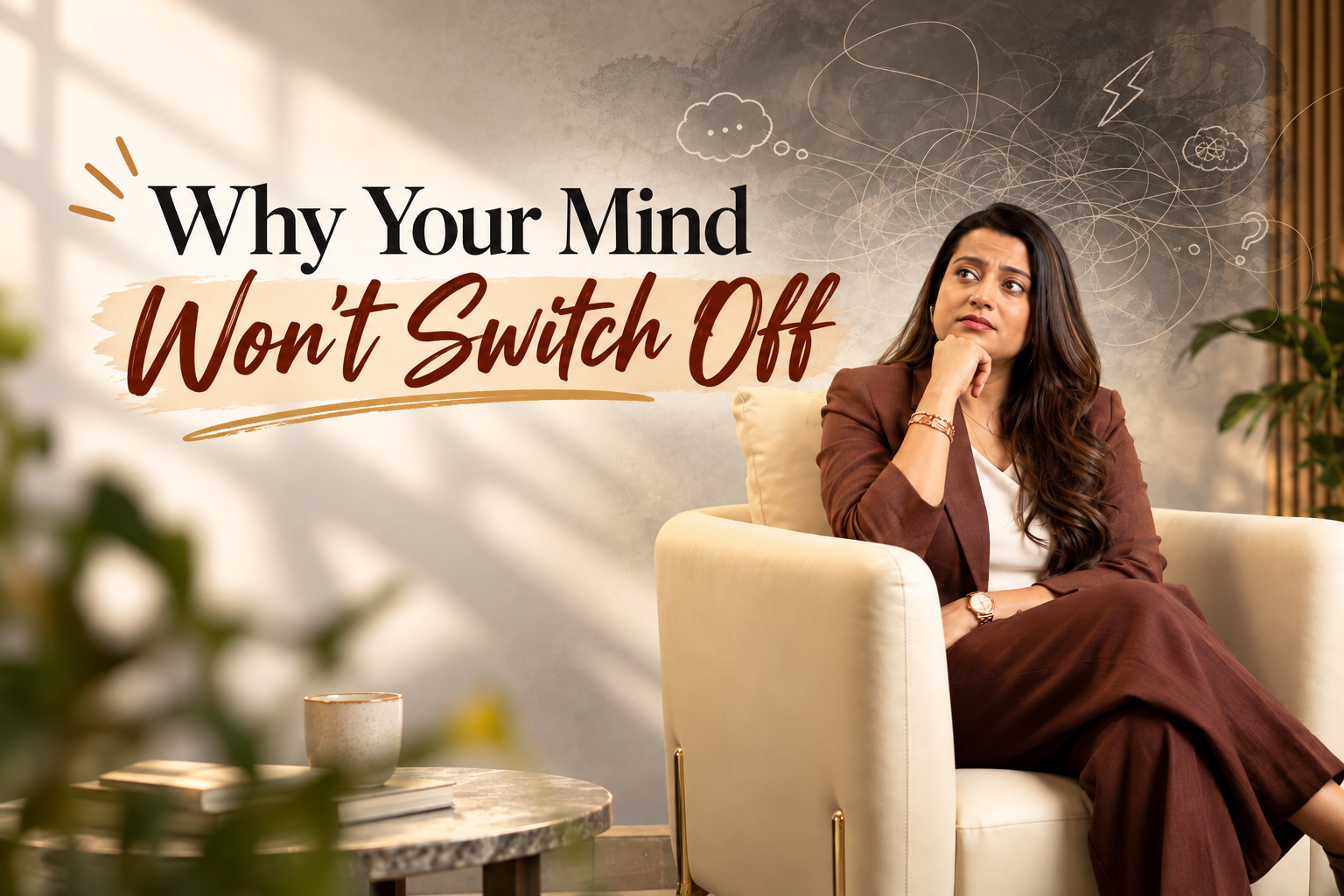
Anxiety and Overthinking: Why Your Mind Won’t Switch Off
You're exhausted, the lights are off, and your mind has just woken up. Here is why that loop happens and how to step out of it.
Have you ever gone to bed exhausted, only to find that your mind suddenly becomes wide awake? You replay a conversation. You analyse something you said. You imagine what could go wrong tomorrow. You think about a decision you made three weeks ago.
Then another thought appears. And another. Before you know it, your mind is running through ten different scenarios while your body is begging for rest. This is what anxiety and overthinking can feel like. And sometimes, the hardest part is not even knowing what you are worried about. You simply know that your mind will not switch off.
Anxiety itself is a normal human emotion. It can help us respond to perceived threats and prepare for challenges. But when worry becomes persistent, difficult to control, and starts interfering with everyday life, it may need more attention and support.
What Is the Connection Between Anxiety and Overthinking?
Overthinking and anxiety often feed each other. You experience uncertainty. Your mind wants an answer. So, it starts analysing. The more you analyse, the more possibilities you find. The more possibilities you find, the more uncertain you feel. And that uncertainty creates even more anxiety. It becomes a loop.
For example, imagine sending an important message to someone. They don't respond for three hours. Your first thought might be: “They're probably busy.” Then the mind starts. “Did I say something wrong?” “Are they upset with me?” “Maybe I shouldn't have sent that message.” “What if they misunderstood me?”
Now you are no longer responding to what actually happened. You are responding to dozens of possibilities your mind has created.
Why Does the Mind Overthink?
The brain naturally tries to anticipate problems. Anxiety is often future-oriented, involving anticipation of possible danger or negative outcomes. So, when something feels uncertain, your mind may try to create certainty by thinking harder. But thinking harder does not always create clarity. Sometimes it creates noise.
You may find yourself asking:
- What if something goes wrong?
- What if I make the wrong decision?
- What if they don't like me?
- What if I fail?
- What if I regret this later?
The problem is that the mind can generate an endless number of “what ifs.” And there is no final answer that eliminates uncertainty. That is why trying to think your way out of anxiety can sometimes keep the cycle alive.
How Do You Know When You're Overthinking?
Overthinking can look different for different people. You might:
- Replay conversations repeatedly
- Constantly worry about the future
- Imagine worst-case scenarios
- Keep changing your decisions
- Seek reassurance from others
- Find it difficult to concentrate
- Struggle to relax
- Feel mentally exhausted
- Have difficulty sleeping
- Avoid making decisions because you are afraid of making the wrong one
Anxiety can also show up physically through symptoms such as tension, difficulty sleeping, increased heart rate, headaches, stomach problems, and difficulty concentrating. So sometimes the question isn't: “Why am I thinking so much?” It is: “What is my mind trying to protect me from?” That question changes the conversation.
How to Stop Overthinking
The goal is not to force yourself to stop thinking. That usually creates another battle:
- “I need to stop thinking.”
- “Why am I still thinking?”
- “This isn't working.”
And now you're overthinking your overthinking. Classic brain behaviours. Instead, start by noticing the pattern.
1Separate Facts from Stories
Ask yourself: “What do I actually know?” Then ask: “What am I assuming?” For example:
Those are not the same thing. Creating this distinction can help you recognise when your mind has moved from reality into prediction.
2Name the Emotion
Instead of immediately analysing the thought, pause. Ask: “What am I feeling right now?” Is it fear? Embarrassment? Uncertainty? Anger? Disappointment? Self-doubt? Emotional awareness begins with noticing what is happening internally rather than automatically reacting to it. Riddhi's approach similarly centres on recognising emotional patterns without immediately judging them.
3Ask What Is Actually Within Your Control
A lot of anxiety comes from trying to control something that cannot be controlled. You cannot control what another person thinks. You cannot control exactly what happens tomorrow. You cannot guarantee that every decision will work out perfectly. But you can control your next response. You can communicate. You can prepare. You can ask for clarity. You can make the best decision you can with the information you have today. That is where your energy becomes useful again.
4Stop Treating Every Thought as a Fact
A thought is a thought. It is not automatically a prediction. It is not automatically the truth. It is not automatically a command. When an anxious thought appears, try asking: “Is this something I know, or something I fear?”
That small distinction can create space between you and the thought. Evidence-based approaches such as CBT also work by identifying and reframing unhelpful thought patterns rather than simply accepting every thought as true.
What If Acceptance Is Part of the Answer?
Sometimes we make anxiety worse by fighting the fact that we feel anxious. “I shouldn't feel this way.” “Why can't I just relax?” “I should be more confident.” “I need to stop worrying.” Now there are two problems: the original situation, and our resistance to how we feel about it. Acceptance does not mean giving up.
It means acknowledging what is happening internally without immediately judging yourself for experiencing it. This is closely aligned with Riddhi's Acceptance Coaching philosophy, which focuses on understanding internal patterns instead of fighting yourself or forcing yourself into positivity.
You can say: “I am feeling anxious right now.” Without adding: “And there is something wrong with me because I am anxious.” That difference matters.
When Should You Seek Professional Help?
Know when to reach out.
Everyone experiences worry and anxiety at times. But if anxiety is persistent, difficult to control, significantly affects your daily life, sleep, relationships, or ability to function, it is important to seek appropriate professional support. Anxiety disorders are different from occasional worry and can require assessment and treatment from qualified mental-health professionals.
Coaching and personal-development practices can support self-awareness and personal growth, but they should not be presented as a replacement for mental-health diagnosis or treatment. If you are struggling significantly, consider speaking with a qualified psychologist, psychiatrist, doctor or other appropriate mental-health professional.
Your Mind Doesn't Always Need Another Answer
Sometimes what an anxious mind needs is not another hour of analysis. Not another Google search. Not another person telling you that everything will be okay. Sometimes it needs you to pause and notice what is happening.
- What am I feeling?
- What am I assuming?
- What is actually true right now?
- What is within my control?
And perhaps the most important question: can I allow this moment to exist without fighting myself through it? You do not have to solve your entire future tonight. You only have to come back to what is real, what is present, and what you can choose next. Because peace does not always come from finally finding the perfect answer.
Sometimes, it begins when you stop demanding one.
Suggested next step
If your mind constantly feels like it is running in the background, perhaps the real work isn't finding more answers. Perhaps it is understanding what is happening within you. Riddhi's work focuses on emotional awareness, acceptance, and internal resistance, particularly for people who want to respond with greater clarity rather than constantly react to their thoughts and emotions.
Explore Riddhi's Acceptance Coaching approach








Comments