
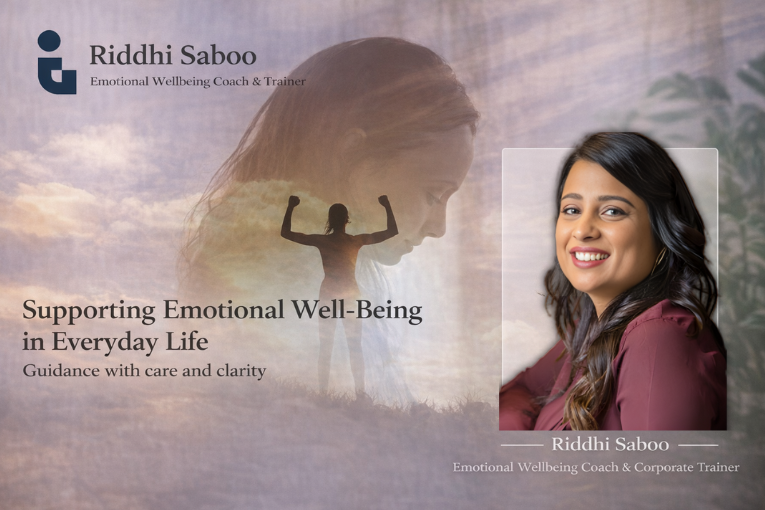
Life does not usually fall apart all at once. Most of the time, it unravels quietly. You continue waking up on time, fulfilling responsibilities, meeting people, and completing tasks. From the outside, everything seems normal. Yet internally, something feels off. There is tiredness that sleep does not fix. There is restlessness without a clear reason. There is a sense of carrying too much, even when nothing obvious has gone wrong.
This experience is becoming increasingly common. People are functioning, but not feeling settled. Achieving, but not feeling fulfilled. Connected digitally, yet emotionally disconnected. At the center of this quiet struggle lies our relationship with our emotions and how we process life internally.
Emotional well-being coach is often spoken about, but rarely understood deeply. It is not a trend or a motivational concept. It is the foundation that determines how we experience life, handle pressure, and relate to ourselves when things do not go as planned.
Looking Beyond the Surface of Emotional Health
Many assume emotional strength means staying positive or calm at all times. In reality, it has very little to do with constant happiness. A healthy inner state allows space for discomfort, disappointment, fear, and uncertainty without letting them dominate one’s life.
Emotional Well-Being Coach balance is the ability to experience feelings fully without being consumed by them. It allows a person to feel sadness without losing hope, anger without becoming destructive, and fear without becoming frozen.
This balance is not something you are born with or without. It develops over time through awareness, reflection, and honest self-observation. People who appear emotionally stable are not free from problems; they have simply learned how to relate to those problems differently.
Why Inner Emotional Well-Being Coach Stability Is So Important Today
Modern life leaves very little room for processing emotions. There is constant pressure to move forward, perform better, and stay productive. Pausing is often seen as laziness. Expressing emotional difficulty is sometimes seen as weakness.
As a result, many people suppress what they feel just to keep going.
Over time, this suppression shows up in subtle ways:
- Constant mental fatigue
- Irritability over small things
- Difficulty enjoying achievements
- Feeling disconnected from oneself
- Lack of motivation despite effort
Ignoring inner health does not make it disappear. It only pushes it deeper, where it quietly affects decisions, relationships, and self-esteem.
Awareness: The First Step Toward Emotional Balance
Before Emotional Well-Being Coach can be managed, they must be noticed. Awareness is the skill of recognizing what is happening inside you without immediately reacting or judging it.
Most emotional reactions are automatic. A comment triggers defensiveness. A mistake triggers shame. A delay triggers anxiety. These responses are often rooted in past experiences rather than the present moment.
When awareness is developed, you begin to notice patterns:
- Certain situations always create tension
- Specific people trigger emotional reactions
- Particular thoughts lead to self-doubt
This noticing creates space. In that space, you gain the ability to choose how you respond instead of being controlled by habit.
The Relationship Between Stress and Emotional Health
Stress is unavoidable. What makes the difference is how stress is processed internally.
Some people carry stress long after the situation has ended. Their mind keeps replaying conversations, worrying about outcomes, or imagining problems that may never happen. Others are able to experience stress, learn from it, and then let it go.
The difference lies in emotional regulation.
Healthy emotional regulation includes:
- Allowing stress-related feelings instead of resisting them
- Avoiding harsh self-judgment during difficult moments
- Returning attention to the present when the mind spirals
- Knowing when to slow down instead of pushing harder
Simple habits such as mindful breathing, quiet reflection, or journaling help the nervous system settle. These are not dramatic techniques. They are small practices that support inner semotionaltability over time.
How Emotional Balance Affects Relationships
Relationships reveal emotional patterns more clearly than almost anything else. The way we communicate, react, and express needs is deeply influenced by our inner state.
When emotional awareness is limited:
- Conversations become defensive
- Misunderstandings escalate quickly
- Feelings remain unspoken
- Emotional distance grows
When inner health is supported, communication changes naturally. People listen more carefully. They respond instead of reacting. They express discomfort without blame.
Healthy relationships are not perfect. They are built on emotional responsibility—the ability to manage one’s own feelings rather than expecting others to do it for us
Emotional Stability and Self-Worth
Many people unknowingly tie their sense of worth to performance. Success brings confidence, while mistakes bring self-criticism. This creates an unstable foundation where self-esteem rises and falls with external results.
True self-worth is internal. It is the quiet understanding that you have value even when you struggle, fail, or feel uncertain.
When emotional resilience improves:
- Inner dialogue becomes kinder
- Mistakes feel like feedback rather than failure
- Growth feels safer
- Confidence becomes more consistent
This shift changes how people approach life. They take healthier risks, set better boundaries, and stop seeking constant validation.
The Impact of Emotional Well-Being Coach Health at Work
Workplaces often prioritize output while overlooking emotional strain. Over time, this imbalance leads to burnout not because of workload alone, but because emotions are ignored.
Professionals who maintain emotional balance tend to:
- Make clearer decisions
- Handle pressure more calmly
- Communicate more effectively
- Maintain energy over longer periods
When inner resilience is supported, productivity becomes sustainable rather than exhausting.
Simple Daily Practices That Support Inner Balance
Supporting emotional well-being coach does not require major lifestyle changes. It grows through small, consistent habits.
Some practical examples include:
Daily emotional check-ins
Taking a few moments to ask yourself how you actually feel.
Pausing before reacting
Allowing a brief pause before responding to stress or conflict.
Healthy emotional expression
Writing, talking, or reflecting instead of suppressing feelings.
Physical regulation
Movement, rest, and breathing help regulate emotions naturally.
Setting boundaries
Protecting emotional energy by knowing when to say no.
These habits may seem simple, but over time they build strong emotional resilience.
Understanding Emotional Well-Being Coach Setbacks
Growth is rarely linear. There will be moments when old patterns return or emotions feel heavier again. This does not mean progress has been lost.
Inner health includes patience. It involves understanding that emotional growth happens in layers.
Real progress looks like:
- Recovering faster after setbacks
- Recognizing triggers earlier
- Responding more consciously
- Practicing self-compassion
This kind of growth is quiet but lasting.
When External Support Becomes Important
There are times when self-help is not enough. Seeking support is not a sign of weakness. It is a sign of awareness.
Guidance can be helpful when:
- Emotional Well-Being Coach feel overwhelming or constant
- Daily functioning is affected
- Past experiences continue to influence the present
- Self-effort no longer feels effective
Support provides perspective and tools that help restore balance.
Emotional Well-Being Coach as a Long-Term Practice
Emotional well-being coach is not something you achieve once and forget. It is an ongoing relationship with yourself.
Life will continue to bring uncertainty, pressure, and change. Inner balance allows you to face these experiences without losing clarity or self-connection.
It helps you stay grounded even when circumstances are unstable.
Conclusion: Choosing Inner Stability in a Noisy World
Emotional well-being coach is not about fixing yourself. It is about understanding yourself.
It is the quiet strength that allows you to face life with awareness instead of avoidance, compassion instead of criticism, and resilience instead of exhaustion. In a world that constantly demands more, learning to care for your inner state is one of the most meaningful choices you can make.
When emotional balance is nurtured, life does not become perfect but it becomes more steady, more intentional, and more aligned with who you truly are.